IPv4 Subnetting & CIDR Guide: How to Calculate Usable Host Ranges, Subnet Masks & Binary Maps

Figure 1.0: Real-time client-side IPv4 CIDR subnetting and security isolation across cloud VPCs and local network gateways.
Whether you are designing an AWS VPC, configuring firewall access control lists (ACLs), setting up WireGuard VPN subnets, or studying for CCNA certification, IPv4 Subnetting and CIDR (Classless Inter-Domain Routing) is the foundational architecture of the modern internet.
Understanding how binary bits divide network routing identifiers from assignable host devices is crucial for optimal IP allocation and enterprise network isolation.
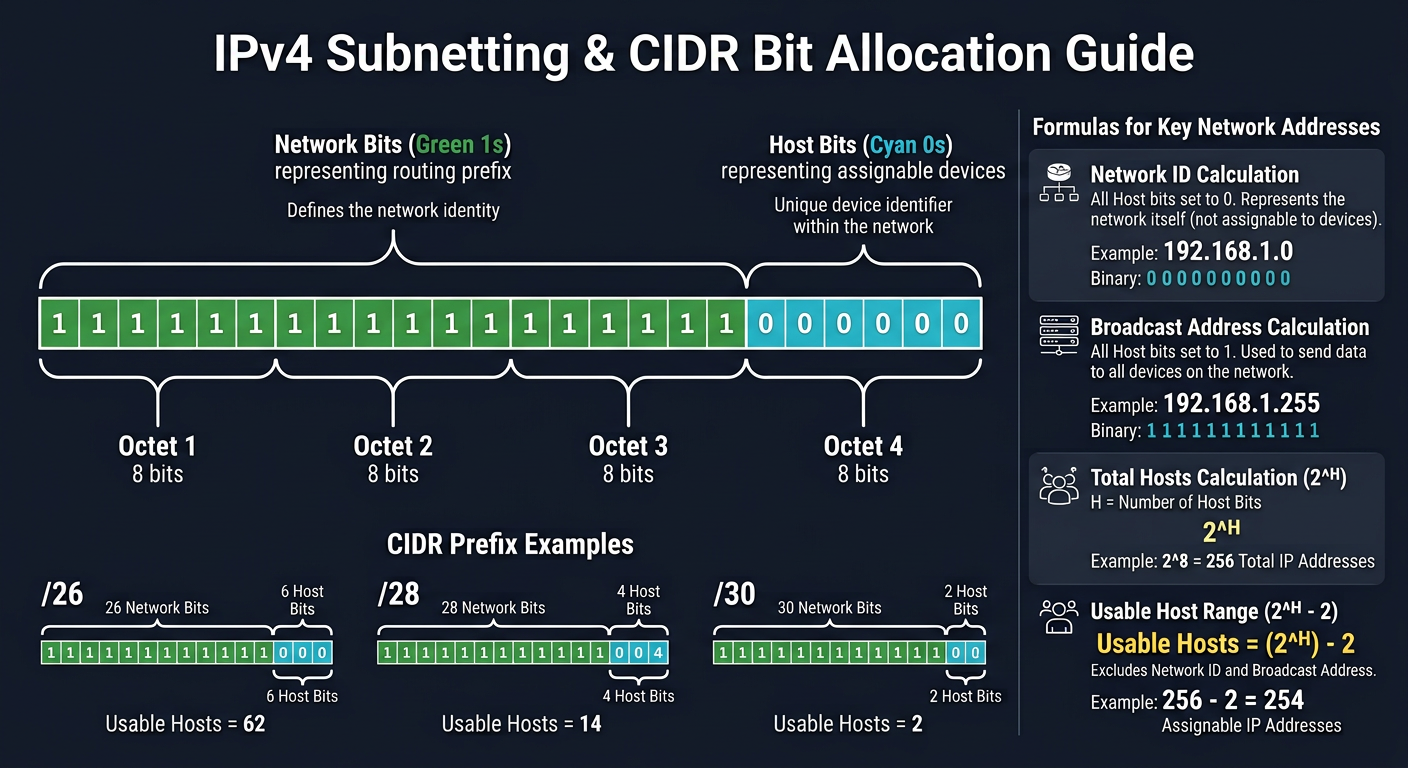
Figure 2.0: 32-bit binary breakdown of Network routing bits (1s) vs Host assignable bits (0s) and mathematical formulas for Network ID, Broadcast, and Usable IP capacity.
Anatomy of an IPv4 Address: 32 Bits in 4 Octets
Every IPv4 address consists of 32 binary bits divided into four 8-bit octets. The CIDR prefix determines exactly where the network boundary ends and the host space begins.
Essential Subnet Formulas:
-
• Total IP Addresses:
2^(32 - CIDR) -
• Usable Host Devices:
2^(32 - CIDR) - 2(Subtracts Network ID and Broadcast Address) -
• Wildcard Mask (ACLs): Inversion of the Subnet Mask (
255.255.255.255 - Subnet Mask)
100% Client-Side Subnetting with PrivacyKit
PrivacyKit Subnet Calculator executes all 32-bit bitwise binary operations entirely in your browser memory with zero cloud telemetry or IP logging.
Try our IP Subnet & CIDR Privacy Calculator
Calculate CIDR blocks, usable IP host ranges, subnet masks & 32-bit binary maps. 100% in-browser, no upload required.
Related Privacy Articles
2026-09-29
How to Forensically Strip Hidden Metadata from Photos and PDFs: Terminal CLI vs In-Browser Zero-Knowledge Cleaning
Discover how to permanently remove GPS EXIF tags, author revision trees, and hidden IDs using Linux commands (exiftool, qpdf, mat2) or client-side browser engines.
2026-09-29
How to Remove Hidden GPS Location and EXIF Data from Photos Before Sharing (iPhone, Android & PC)
Learn how smartphone photos secretly record your exact home address via EXIF GPS tags, and how to safely strip location metadata before sharing online.