Zero-Trust AI Prompt Sanitization: How to Protect Sensitive Data in the Agentic Era
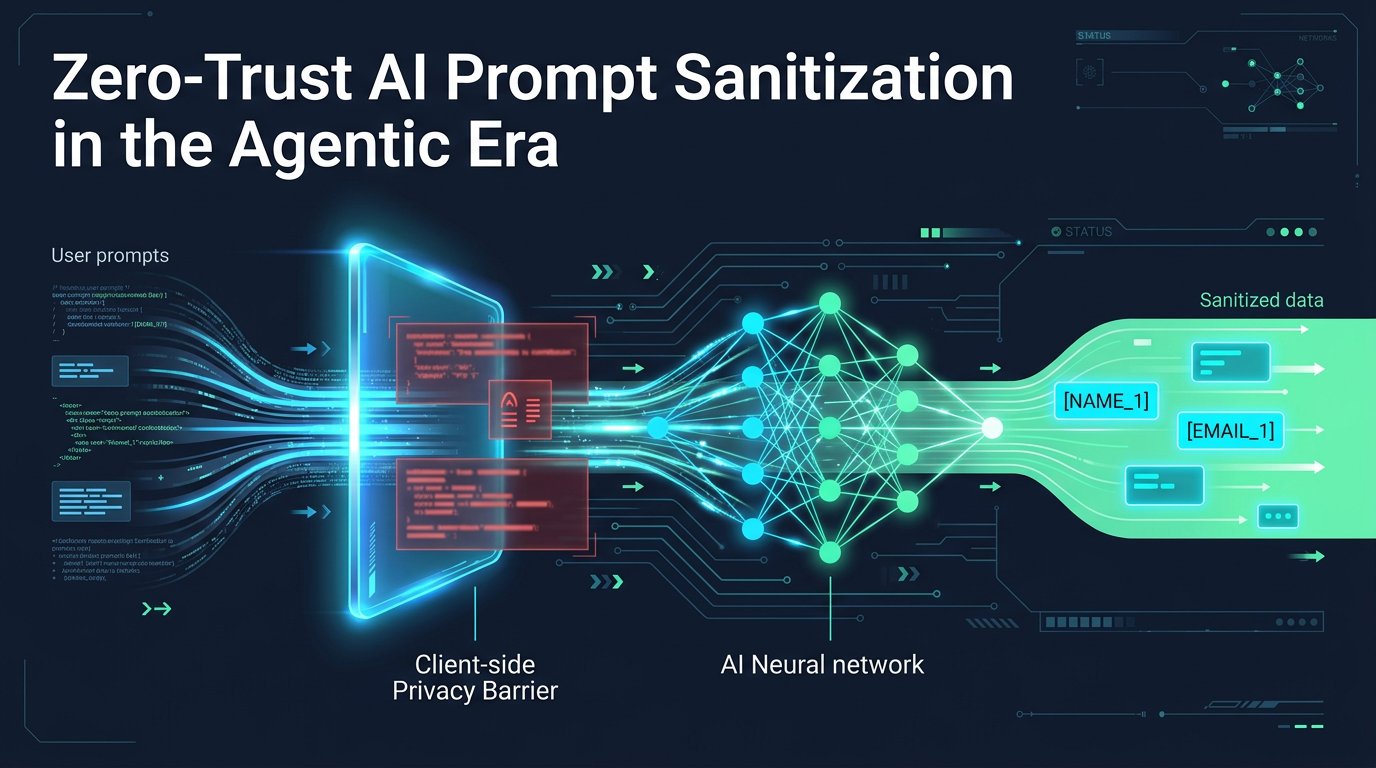
Figure 1.0: Real-time client-side prompt sanitization separating raw user inputs from cloud-hosted neural network inference layers.
As autonomous AI agents and enterprise generative models become central to everyday engineering and operational workflows, the boundary between internal confidential data and external AI telemetry has dissolved.
When employees prompt models with unmasked error traces, customer correspondence, or financial spreadsheets, that information traverses public networks into third-party cloud infrastructure. Under frameworks like GDPR, HIPAA, and the European Union AI Act, transmitting unredacted personal identifiers constitutes an unvetted data transfer event.
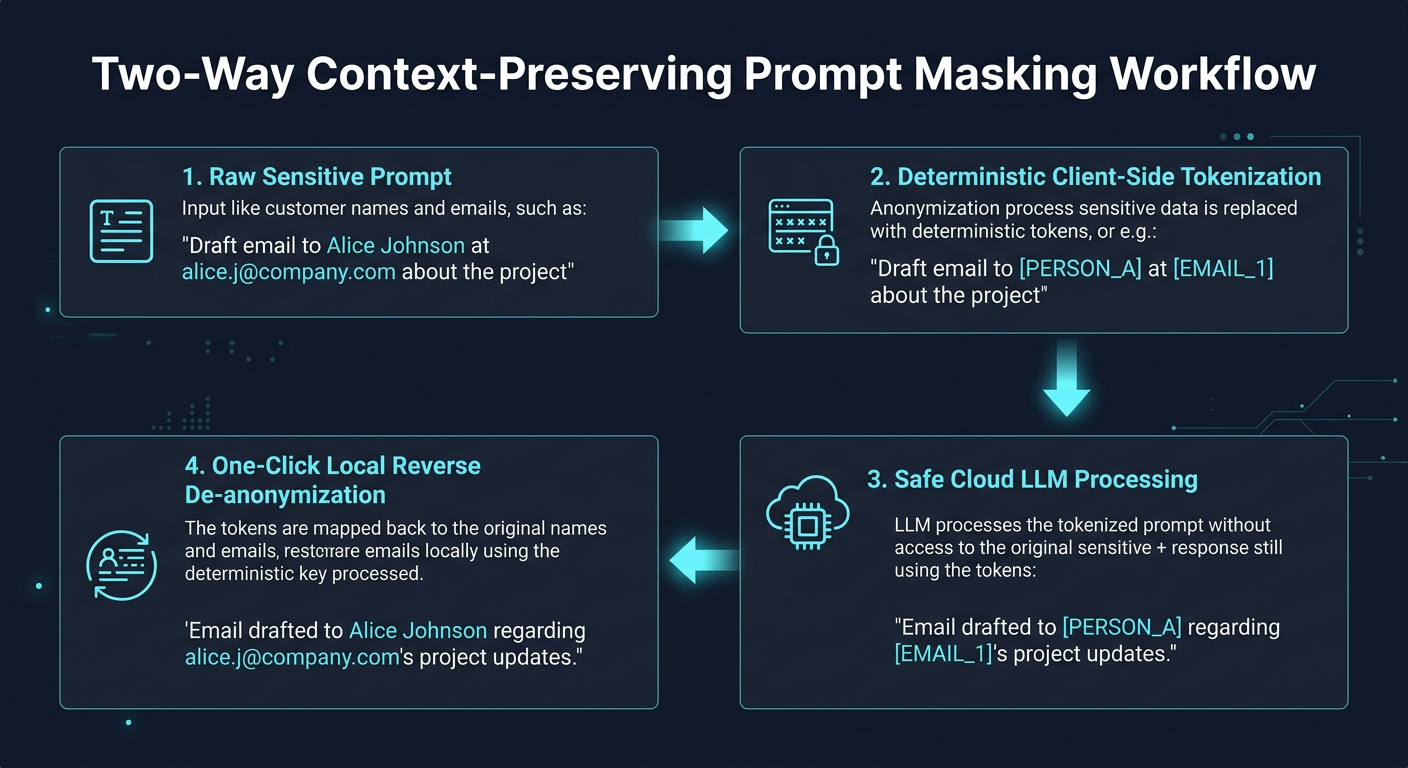
Figure 2.0: The complete four-stage lifecycle of deterministic two-way context-preserving prompt sanitization.
Why Traditional Blackout Redaction Fails AI Models
Historically, compliance teams addressed privacy with rigid search-and-replace rules, swapping confidential strings with generic markers such as [REDACTED] or XXXX.
While this prevents exposure, it degrades the logical reasoning capacity of modern language models:
- 1. Destruction of Entity Relationships: If multiple distinct names, email addresses, and account numbers are replaced with the same static placeholder, the model loses the ability to discern who performed which action.
- 2. Grammatical and Structural Distortion: Blanking out words creates unnatural token breaks, often triggering syntax hallucinations and degraded code output.
- 3. Irreversible Workflow Bottlenecks: Black-box redaction is one-way; once processed by an AI, a user must manually cross-reference and reconstruct every replaced term by hand.
The Solution: Two-Way Context-Preserving Masking
To maintain full model reasoning without exposing real-world identities, modern security workflows use deterministic two-way masking:
- Structured Token Substitution: Real customer names are mapped to contextual surrogates (e.g.,
Alice Johnson→[PERSON_A]). - Semantic Continuity: Contact points and numerical data retain their structural roles (e.g.,
alice.j@company.com→[EMAIL_1]). - Local Key Restoration: A temporary in-memory key table retains the bidirectional mapping exclusively within your browser session. Once the AI generates its analysis using the placeholders, a single reverse operation re-populates the original confidential values.
Client-Side Zero-Knowledge Execution
Sending confidential text to a cloud-based "redaction API" simply shifts the security liability to another third party.
True zero-trust data hygiene requires sanitization to happen entirely in client-side memory. With in-browser execution, regex parsing and surrogate generation execute locally in JavaScript before network packets leave your computer.
Try our AI Prompt Anonymizer & Restorer
Mask names, companies, [brackets] & amounts before AI, restore with 1 click. 100% in-browser, no upload required.
Related Privacy Articles
2026-09-30
IPv4 Subnetting & CIDR Guide: How to Calculate Usable Host Ranges, Subnet Masks & Binary Maps
Master IPv4 subnetting and CIDR prefix notation (/8 to /32). Learn how to determine Network IDs, Broadcast addresses, usable IP host ranges, and binary bit allocation.
2026-09-29
How to Forensically Strip Hidden Metadata from Photos and PDFs: Terminal CLI vs In-Browser Zero-Knowledge Cleaning
Discover how to permanently remove GPS EXIF tags, author revision trees, and hidden IDs using Linux commands (exiftool, qpdf, mat2) or client-side browser engines.